
Turning on a tap and expecting water to flow is one of the quiet assumptions of modern life. It happens so automatically that we rarely stop to think about how unusual that reliability really is.
Australians are perhaps more aware of water scarcity than many countries. Drought cycles are part of the landscape, and policies such as rainwater tanks on new homes — now common in places like South Australia — reflect that awareness. These measures recognise an important reality: water supply cannot always be assumed to be unlimited.
But resilience is not only about capturing water when it falls. It is also about understanding how the systems that deliver and distribute that water behave when conditions become more difficult.
When water supply is interrupted today, the cause is usually local and temporary. A burst pipe, maintenance work or a faulty valve may leave a street without water for a few hours. The inconvenience is frustrating but short-lived, and the expectation is that normal service will return quickly.
A different situation arises when supply itself becomes constrained.
Australia’s climate has always included drought cycles, but many regions are now experiencing longer dry periods punctuated by more intense rainfall events. Heavy storms can deliver large volumes of water in a short time, yet much of that runoff cannot be captured efficiently in reservoirs designed around steadier inflows. At the same time, higher temperatures increase evaporation from both soils and storage systems.
In that environment, resilience becomes less about temporary disruptions and more about how households will manage when supply is limited.
Electricity failures are disruptive. Water failures are more serious. A household can function without power for a time, even if comfort is reduced. Without water, basic hygiene, cooking and sanitation quickly become difficult. Access to clean water is widely recognised as a fundamental human right.
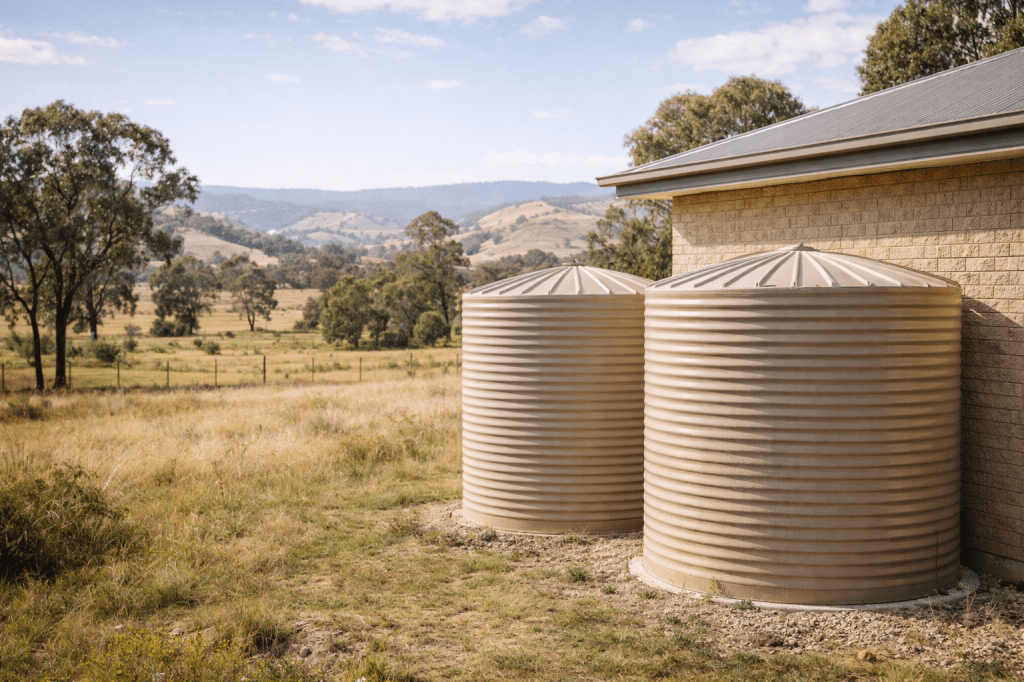
Rainwater tanks are one way homes can provide a small degree of independence and reduces pressure on centralised infrastructure and provides a local reserve during periods of drought and water restrictions.
In South Australia, this approach is already widely recognised. Rainwater tanks have long been part of domestic life and are now required on most new homes.
But storage alone does not automatically create resilience.
Many rainwater tanks rely on electric pumps to supply water into the home. If power is lost, the stored water may no longer reach the taps inside the house.
Once those dependencies are recognised, simple ideas start to appear. A small tank positioned higher than the house can supply water by gravity when pumps stop working. A hand pump could lift water from a larger tank when power is unavailable. These kinds of practical solutions do not replace the main water supply — but they can help households cope when normal services are disrupted.
None of these ideas are complex. But they illustrate how resilience often begins with understanding how everyday systems depend on one another.
The goal is not independence from public infrastructure. Large-scale systems will always remain essential. The goal is simply to ensure that homes are not completely dependent on uninterrupted supply.
Electricity affects comfort.
Water affects survival.
Designing homes that recognise that distinction is not alarmism. It is simply prudent planning for the decades ahead.
 The Pieces Fit - homepage
Leave a comment