
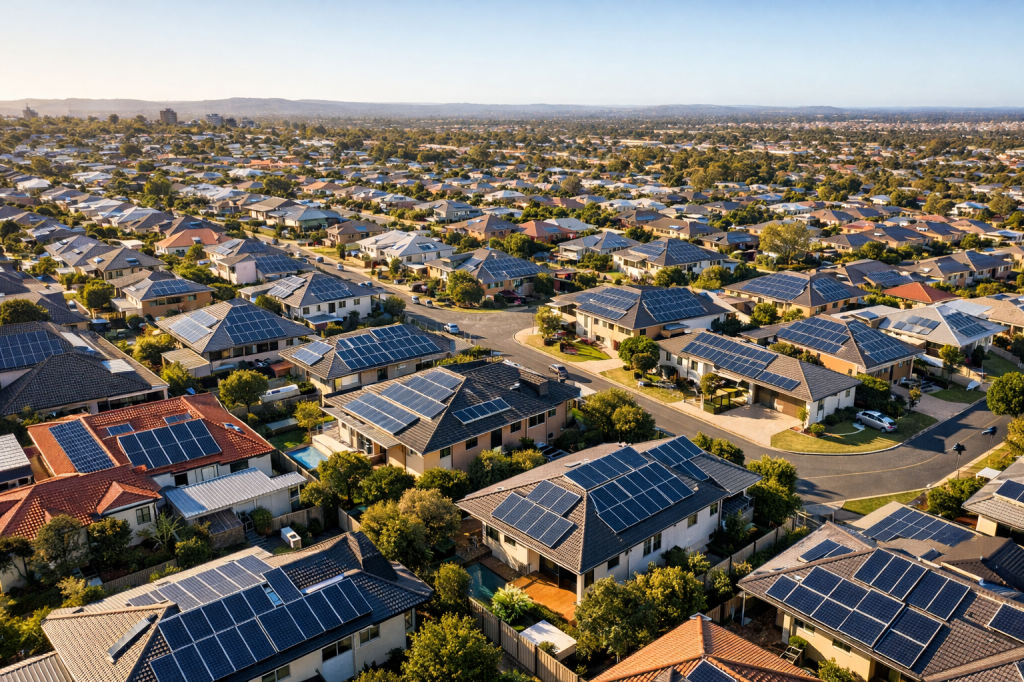
If your home has rooftop solar power, you will know that when the grid fails, your rooftop solar system shuts down too. It is the way the system was designed when solar power first entered the domestic market.
When power lines are damaged or crews are working to restore supply, electricity must not be fed back into the network from rooftop solar systems. To prevent that, inverters are programmed to switch off automatically when they sense loss of the grid power goes. This protection — known as anti-islanding — exists for one reason: safety. Line workers cannot risk live cables being energised from thousands of suburban rooftops. Safety is paramount.
But the way rooftop solar has been configured in Australia reflects its original purpose.
It was introduced to reduce electricity bills and lower emissions. It was designed to feed energy into the grid during the day and draw from it at night. It was not designed to allow homes to operate independently when the network fails. The distinction matters.
On a hot summer afternoon, when rooftops across a suburb are generating significant power, that energy becomes unavailable to households the moment the grid drops out. It is not that the panels stop producing electricity. It is that the system is not configured to let homes use it safely in isolation.
The technology to do this exists. Hybrid inverters, isolation capability and essential-load circuits can allow a home to operate independently while still protecting network workers. But resilience was not the primary design objective when rooftop solar was rolled out at scale.
The objective was efficiency and decarbonisation. Those were necessary first steps.
But in a climate where heatwaves coincide with grid stress and outages, the limitations of that configuration are becoming clearer. A system designed purely for export and synchronisation does little to support households during failure.
Batteries can help — but only if they are sized and wired with resilience in mind. Many are installed to optimise financial return, not to provide multi-day autonomy during extreme heat events.
The question is no longer whether rooftop solar reduces emissions. It clearly does. The question is whether our electrical standards and installation practices now need to evolve — from a model focused solely on efficiency and export, to one that also prioritises household resilience.
Solar was designed to work with the grid. The next stage may require it to work safely without it.
In a country defined by drought cycles, energy is only half the resilience equation. In the next post, I’ll look at water — and what happens when supply can’t be taken for granted.
 The Pieces Fit - homepage
Leave a comment