
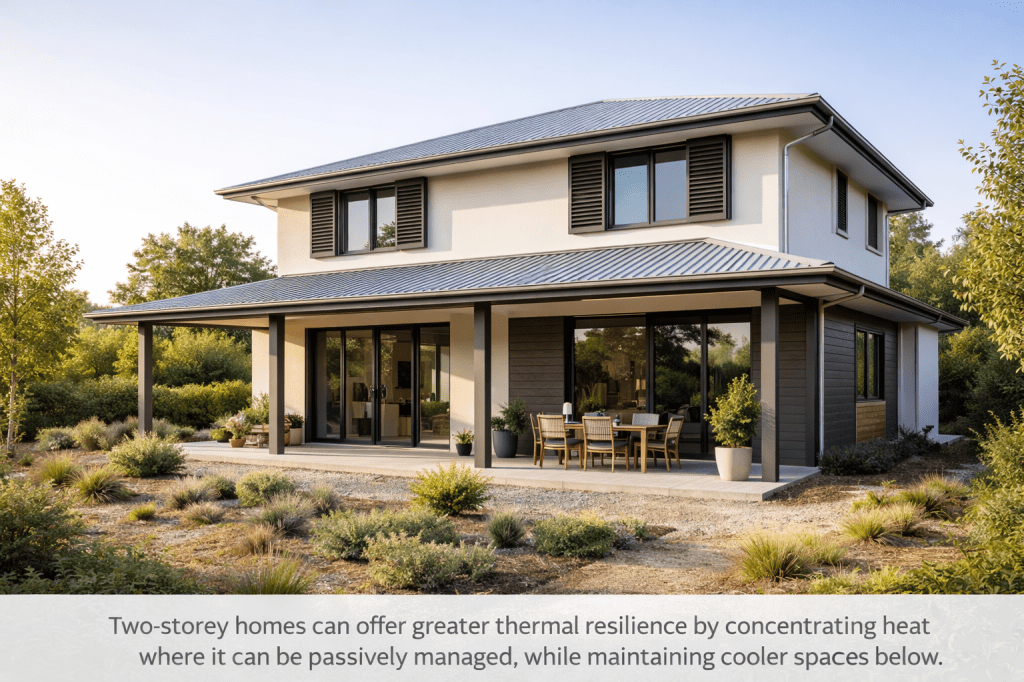
When people build a new home, they are often told they are able to make choices. However, in reality, many of the most important decisions have already been made that have consequential impacts that last far longer than people expect.
In our changing climate, those decisions matter more than ever. A home designed for yesterday’s conditions, and premised on today’s design standards, can lock in discomfort, higher energy use, and vulnerability for decades. Getting new homes right is not about chasing technology or trends. It is about understanding which design decisions we can influence that can have a positive impact on how a building will actually perform over its life.
Homes are designed to comply with current building codes nothing more. And while that may sound reassuring, compliance with standards and codes does not build in long-term resilience to a changing climate.
In Australia, the National Construction Code has required new homes to achieve a minimum 7-Star NatHERS thermal performance since 2022. While this represents progress in energy efficiency, the 7-Star rating is based on reference climate conditions and does not guarantee that homes will remain habitable during prolonged heat events or prolonged loss of power. In a changing climate, resilience — the ability to moderate internal conditions when systems fail or when extremes exceed historical norms — goes beyond minimum code compliance.
Earlier in this series, I’ve explored how orientation, form, glazing, shading and insulation shape a building’s thermal performance. Those basic principles don’t change — but their importance increases when homes need to remain habitable as temperatures rise and weather extremes intensify. Those decisions, made early in the design phase, determine how much the building will have to rely on mechanical and electrical systems just to remain liveable.
This is where good design becomes critical. Once approvals are granted and construction begins, many opportunities are lost. Retrofitting later is possible, but often costly and constrained. Building a new home offers a rare chance to build resilience in from the outset — not as an upgrade, but as a baseline expectation.
One question is rarely asked during design: how will this home perform when systems fail?
Extreme heat events increasingly coincide with power outages. A resilient home is not one that never needs cooling, but one that can remain habitable for longer when services are disrupted. Passive performance — shading, ventilation, thermal mass and envelope quality — determines whether a home buys time or becomes unliveable within hours.
A related consideration is how a home sheds heat overnight. Night-time passive cooling — achieved through cross-ventilation, purge ventilation, operable windows and appropriate use of thermal mass — allows buildings to release stored heat when external temperatures fall. Designing for this from the outset can significantly improve comfort during heatwaves, particularly when mechanical cooling is unavailable or constrained.
Homeowners often assume that designers, builders or planners will address these issues by default. In practice, design outcomes improve when clients understand the implications of early decisions and being actively involved in the process whilst advocating for better performance, not just compliance, together with an understanding of how the building will perform under stressed conditions.
Once built, poor design decisions are difficult and expensive to undo. That makes the design phase the single most important opportunity to improve resilience, comfort and long-term performance.
In the next post, I’ll look more closely at how building codes, standards and approval processes shape design outcomes — and why “meeting code” is often not enough when designing for the decades ahead.
 The Pieces Fit - homepage
Leave a comment