
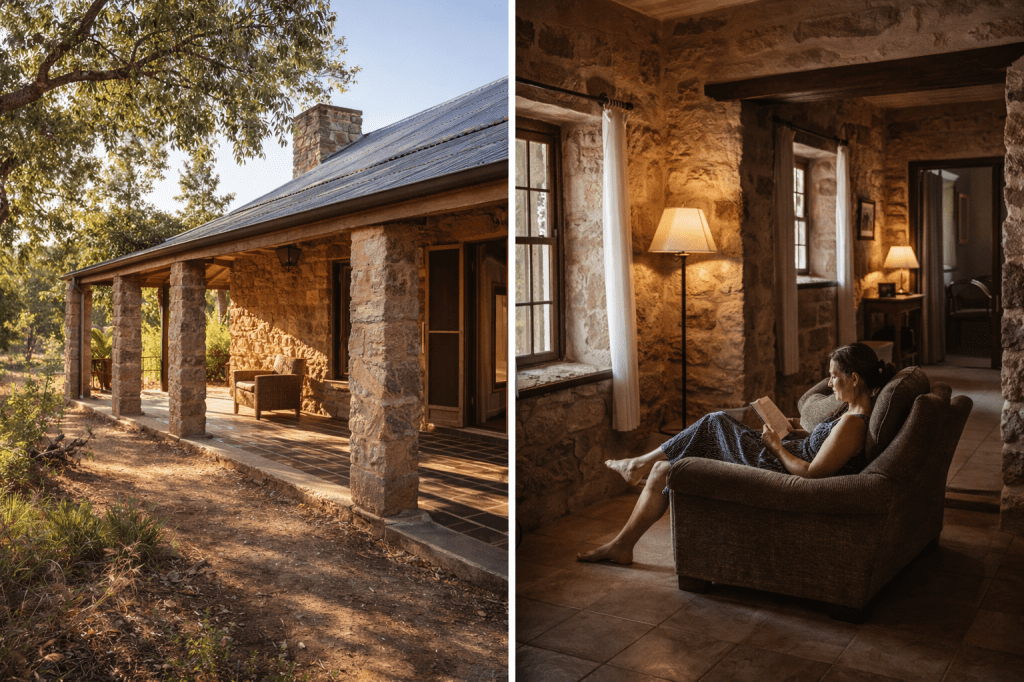
In recent years, extreme heat has become a defining feature of Australian summers. Days over 40 °C are no longer unusual, and periods of sustained heat place enormous strain on electricity networks. When demand peaks, outages follow — often at the very moment mechanical cooling is most needed.
This combination of extreme heat and coincident power loss exposes a hard truth: many buildings are not designed to remain habitable when systems fail.
Passive survivability is the ability of a building to maintain basic, safe living conditions during extreme heat or cold without relying entirely on mechanical systems. It is not about comfort as usual, and it is not about off-grid living. It is about keeping internal temperatures within acceptable limits, protecting occupants, and buying time until services are restored.
At its core, passive survivability depends on a small number of design fundamentals.
External shading is critical. Once heat enters a building through unprotected glazing or poorly shaded walls, it becomes difficult to remove without energy-intensive cooling. Deep eaves, verandahs, adjustable shading and careful control of east and west glazing reduce heat gain before it becomes a problem.
Insulation and airtightness work together to slow the transfer of heat. In hot conditions, they help keep external heat out; in cooler periods, they retain warmth. Poorly insulated buildings respond rapidly to outdoor temperature swings, making them vulnerable during prolonged extremes.
Thermal mass, when used correctly, can moderate internal temperatures by absorbing heat during the day and releasing it slowly when conditions cool. This only works when combined with appropriate shading and night ventilation; without these, mass can just as easily store unwanted heat.
Ventilation strategy matters. Buildings should allow hot air to escape and cooler air to enter when conditions permit. Cross-ventilation, high-level openings, and the ability to purge heat overnight can significantly improve survivability during heat events.
Zoning is often overlooked. Not every room needs to remain comfortable during an outage. Designing a small number of well-protected spaces — places where occupants can retreat during extreme conditions — can dramatically improve safety without adding complexity or cost.
Passive survivability is not a replacement for mechanical systems. Heating and cooling still have important roles to play. But when buildings depend entirely on active systems to remain habitable, failure can quickly make them unliveable rather than merely uncomfortable.
This matters most for those who are least able to adapt quickly: older residents, young children, and people with existing health conditions. It also matters for households that cannot afford generators, batteries or major retrofits. Passive survivability is, in this sense, a matter of equity as much as design.
Most importantly, passive survivability is achievable. It does not require experimental technology or radical lifestyles. It requires that buildings are designed — or modified — to cope when conditions exceed expectations and systems are unavailable.
In the next post, I’ll look at what this means for the existing housing stock — and what can realistically be retrofitted to improve resilience in homes that were never designed for our changing climate.
 The Pieces Fit - homepage
Leave a comment