
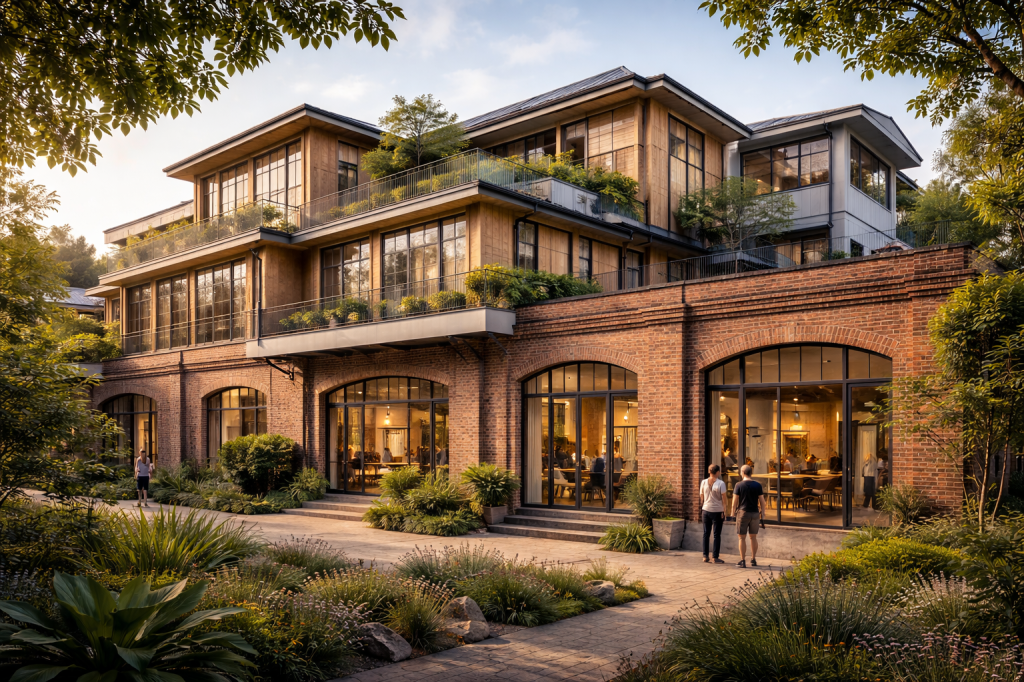
Buildings are often described as permanent, but in reality they are only as durable as the assumptions they are built on. Over a lifespan of 50 to 100 years, climate conditions will change, technologies will evolve, and the way spaces are used will shift — sometimes in ways that cannot be predicted at the time of design.
Adaptability is therefore not an optional extra. It is a core performance requirement.
Most buildings are still designed around a narrow snapshot in time: a particular climate baseline, a fixed use, and a set of technologies assumed to remain relevant. When those assumptions change — as they inevitably do — buildings struggle. They become inefficient, uncomfortable, expensive to modify, or prematurely obsolete.
Designing for adaptability means accepting uncertainty from the outset. It means recognising that future occupants may use spaces differently, that systems will need to be upgraded, and that climate conditions will not remain static. Buildings that can accommodate change without major structural intervention are more resilient, more economical over time, and ultimately more sustainable.
Adaptability begins with form and structure. Regular grids, generous floor-to-ceiling heights, and logical load paths make it easier to reconfigure spaces as needs change. Structural systems that allow flexibility reduce the cost and complexity of future alterations. Once these decisions are locked in, they are difficult — and often impossible — to reverse.
It also extends to services and systems. Designing with access, separation and capacity in mind allows mechanical, electrical and hydraulic systems to evolve as technology improves. Buildings that can accept new systems without invasive retrofits are far better placed to respond to changing energy requirements and regulatory standards.
Climate adaptation reinforces this need. Rising temperatures, more intense rainfall, longer dry periods and increased fire risk place new demands on buildings over time. Designing for future extremes — rather than historical averages — reduces the likelihood that buildings will require costly upgrades simply to remain habitable.
Perhaps most importantly, adaptability supports longevity. The most resource-efficient building is one that does not need to be replaced. Every avoided demolition saves not only embodied energy, but the disruption and material consumption that comes with rebuilding.
In this sense, adaptability is not about predicting the future accurately. It is about designing buildings that can cope with uncertainty gracefully. Buildings that can change use, accept new technologies, and respond to a changing climate are buildings that remain relevant.
As this series has explored, form, materials, thermal performance and adaptability are deeply connected. Together, they shape whether buildings remain assets over generations — or liabilities that must be continually corrected. Designing for change is not a concession to uncertainty; it is a recognition that change is inevitable.
In the next series, I’ll look at what resilience really means for buildings — and how homes can remain habitable during extreme conditions and service outages.
 The Pieces Fit - homepage
Leave a comment