
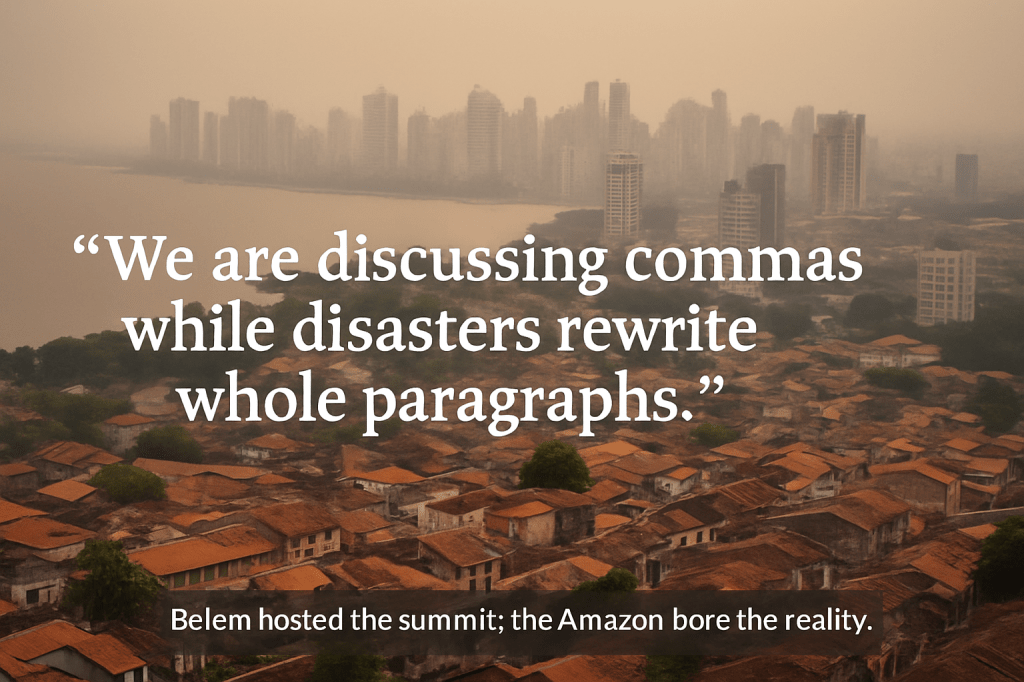
“It shouldn’t take a conference to remind us of what the world already knows”
I was genuinely saddened when I read the BBC’s account of COP30. Not surprised — but saddened. What happened in Belém wasn’t a step forward, or even a pause; it was a reminder of how fragile global climate diplomacy has become, and how quickly the world is drifting from the path it needs.
The summit ended without a roadmap to phase out fossil fuels. With China and the US largely absent, Russia, Saudi Arabia and other oil exporters blocked any language that threatened their interests — openly, confidently, and without consequence. There was no counterweight.
And the European Union, once the backbone of climate ambition, has become a tiger without teeth: willing to pour billions into adaptation, willing to shoulder responsibility, but unable to secure even a symbolic shift from the countries most committed to expanding fossil fuel production. Europe pays; others decide. That imbalance now defines the process.
Tripling adaptation finance sounds like progress until you recognise what it represents: not momentum, but resignation. We do need to adapt to what’s coming, but not at the expense of avoiding the harder task — reducing our reliance on fossil fuels. Because when countries fail to cut fossil-fuel consumption, adaptation becomes triage: managing the impacts rather than limiting them.
COP30 doesn’t end hope, but it makes clear that global negotiations are no longer driving climate action. The future won’t be shaped by what leaders failed to agree on at Belém, but by whether the countries, states and cities with the capacity to act — especially the major emitters — are willing to move forward independent of their national governments.
From the outcomes of COP30, it’s clear the pieces aren’t being driven by a unified, coordinated strategy to stabilise our climate — or to ensure future generations inherit a planet they can still thrive in. So the question becomes: what can be done now, and who is left to lead?
 The Pieces Fit - homepage
Leave a comment