
A forgotten railway, a silent desert, and the enduring rhythm of a pilgrim’s journey.
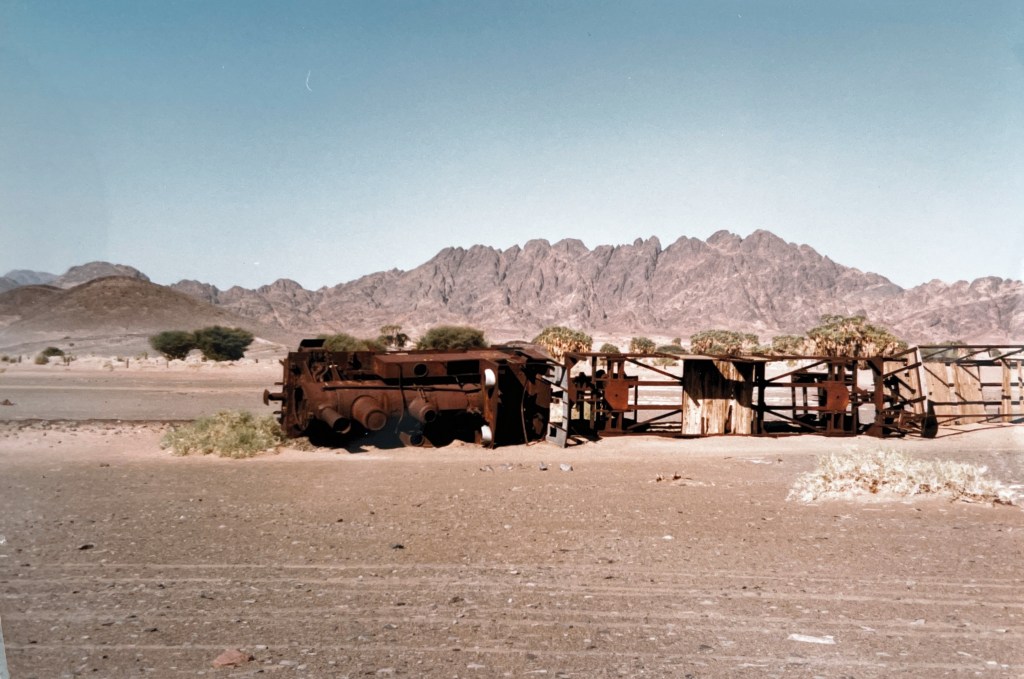
The wreckage of the old Hejaz Railway, photographed north of Medina — the desert has reclaimed the line, yet its story endures.
(Photograph © Michael Shearwood)
“The desert is clean. It is a place of truth. In the desert, a man comes face to face with himself.”
Attributed to T.E. Lawrence.
There’s a stretch of desert between Tabuk and Al-Ula where time seems to pause. The old Hejaz Railway, once linking Damascus to Medina, still traces its way through the sand — a rusted memory of steam, ambition, and devotion.
Built by the Ottoman Empire in the early 1900s to carry pilgrims to Mecca, the line was both an engineering feat and a spiritual lifeline. Yet its existence was short-lived. Sabotaged during the Arab Revolt and slowly reclaimed by the desert, it became a symbol of how progress and purpose sometimes meet the same fate — silence.
When I travelled along that disused line years ago, many of the old carriages and engines still lay where they had fallen — skeletal reminders of another age. One of them, half-buried and leaning on its side, became the subject of my sketch, Long Way Home.
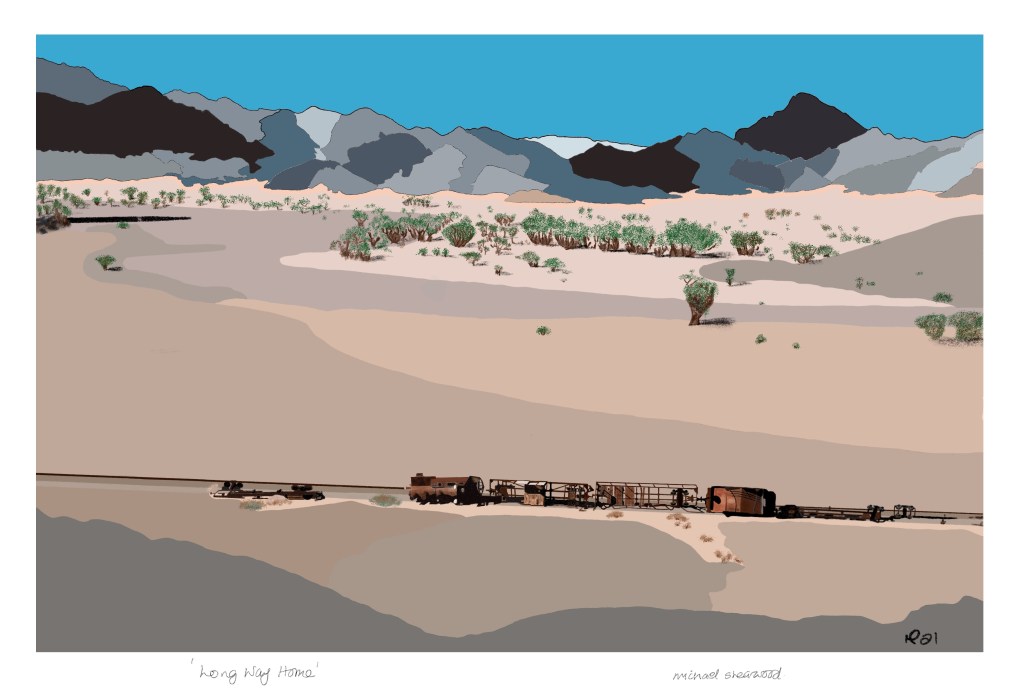
Standing there with the desert wind in my face and the dark Hejaz mountains rising in the distance, it was impossible not to feel a connection — not just to the history, but to the human spirit to keep moving forward, no matter how long the way home might be.

That scene stayed with me long after I left the desert. Later, I tried to capture it — not as a record, but as a reflection — in a digital sketch I titled Nevermind. The locomotive, once built to transport the pilgrims, now rested in fragments, yet in its stillness there was a strange perseverance — a sense that meaning survives, even after destruction.
Today, Saudi Arabia now welcomes visitors on tourist visas, and so the Hejaz route is once again accessible to travellers and history enthusiasts alike. To follow its path — from the old station at Tabuk, through the wild sandstone canyons near Mada’in Saleh (Al-Ula), and south towards Medina — is to trace the line of faith, endurance, and resilience carved into the desert over a century ago.
It’s a journey worth making: part pilgrimage, part exploration, and part quiet conversation with the past. The landscape is vast and still, yet alive with the echoes of those who once travelled it in hope and belief.
“We had to destroy the line to keep it alive.“
T.E. Lawrence – The Seven Pillars of Wisdom
Lawrence’s words capture the paradox of the Hejaz Railway — a line built for faith and unity, yet undone by the same human forces that first brought it into being. Standing among the rusted remains, it’s hard not to feel that tension between purpose and loss — between what we build and what time, or circumstance, takes back.
Even though the railway lies in ruin, its story still connects — faith, history, endurance, and human endeavour all still come together in meaning, and the pieces continue to fit.
 The Pieces Fit - homepage
Leave a comment