
When protest fills the streets and the slogans echo through the towers of Manhattan, it’s worth asking — what are we really defending, and who still holds the crown?
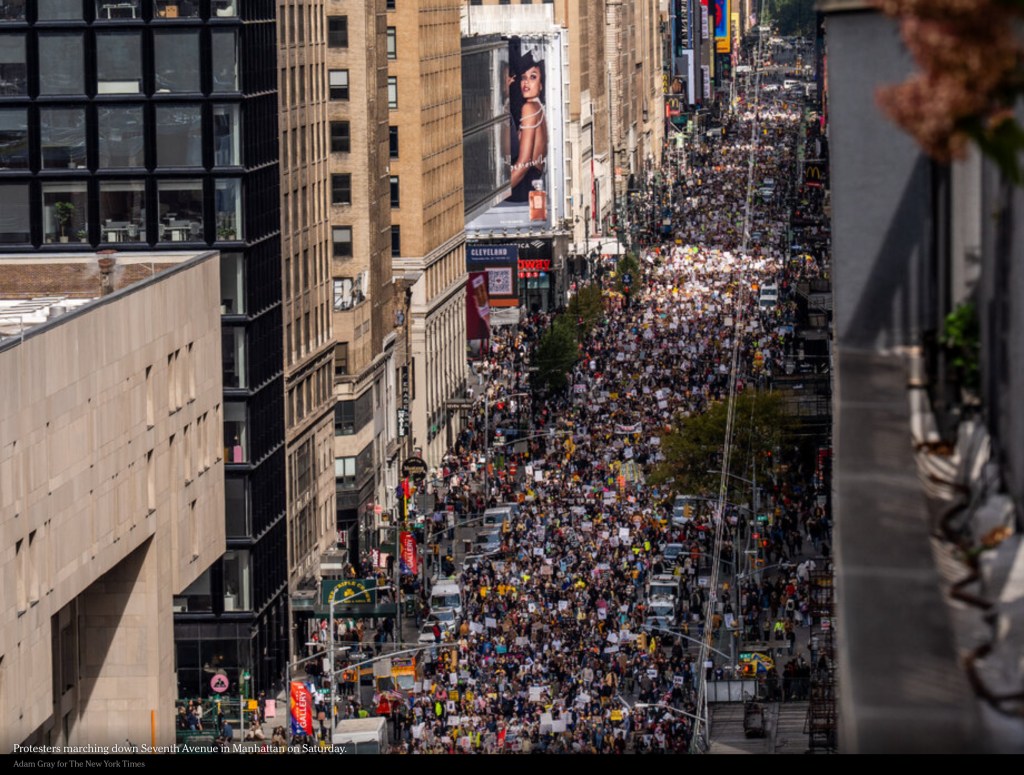
Protesters marching down Seventh Avenue in Manhattan — “No Kings” demonstration
(Photo credit: Adam Gray for The New York Times)
I was reading the New York Times this morning when I came across an article on the demonstrations in New York, with protesters marching under banners that read “No Kings.” The slogan stopped me. There was something haunting about it – an echo from history, a reminder of how revolutions once began with the rejection of crowns and titles.
Yet the irony couldn’t be more striking. Modern constitutional monarchs — those symbolic figures in places like the UK, Sweden, or Belgium — have significantly less power than the U.S. President, who now commands military, legislative, and moral influence that dwarfs anything a monarch could exercise today.
The truth is probably very uncomfortable to most Americans: the American presidency has evolved into a kind of elected monarchy. And the people protesting the idea of monarchy may, without realising it, be living within one.
The Myth of the Model Democracy
For decades, America sold itself as the blueprint for freedom — a nation of laws, not kings. The model democracy. But is it still a model worth following?
The constitutional framework designed in the 18th century has struggled to adapt to a 21st-century world of digital empires, billion-dollar campaigns, and weaponised misinformation. The checks and balances that once ensured accountability now feel like relics, easily bypassed by executive order or partisan paralysis.
Meanwhile, the democratic ideal of representation for all has thinned to a marketing slogan. Who, exactly, does the system represent today? The poor? The working class? Or the wealthiest 20% who fund campaigns, lobby policymakers, and shape the narrative? Democracy, once the voice of the many, increasingly sounds like the echo of the privileged few.
It’s not just an American problem, of course. Across the world, democracies are hollowing out — not collapsing outright, but decaying quietly from within. Voting still happens, parliaments still sit, and flags still fly — yet the decisions often serve those already insulated from consequence.
The Global Deference Problem
Perhaps the more troubling question is why so many nations still genuflect to the American model — politically, culturally, even militarily — as though it remains the gold standard. The assumption that “democracy equals America” is a habit the world struggles to break.
But a system that allows billionaires to buy elections, courts to become partisan battlegrounds, and truth itself to be optional — is that really a model to emulate? Or is it a warning of what happens when democracy becomes performance – an illusion of democracy still working, even as its mechanisms are hollowed out by wealth, influence, or partisan capture.?
Do the Pieces Still Fit?
Maybe that’s the larger question — not just for America, but for all of us. Do the pieces still fit? Can systems built on ideals of equality and accountability still function in societies driven by inequality and influence?
Perhaps the answer lies in remembering that democracy, like any living system, must evolve or it dies. It isn’t sacred because it’s American or Western — it’s sacred only when those elected to govern never forget who they are meant to represent. A president is chosen to act on behalf of the people, not to rule over them. Yet too often, the office drifts towards serving the interests of the powerful – the donors, the lobbyists, the few – rather than the electorate itself. That imbalance is what corrodes trust and should be resisted by all who still believe in the promise of democracy.
The protestors on Seventh Avenue may have shouted “No Kings,” but the deeper plea is this: “No illusions“. Even in republics, when the presidency forgets it is meant to represent rather than rule, then democracy wears a crown once more – and the people lose their voice: their right to be represented, to be heard, and to reclaim democracy from those who wield it like a private instrument.
 The Pieces Fit - homepage
Leave a comment