
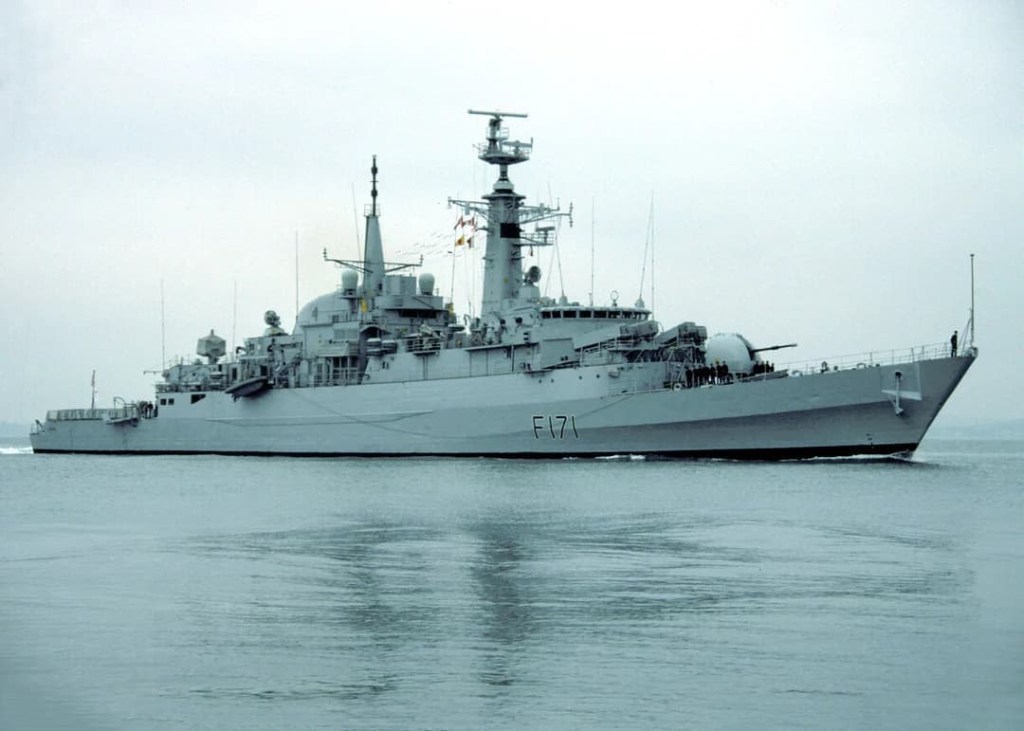
HMS Active F171 – Type 21 Frigate also known as …
“The sleek grey messenger of death.”
Unknown
Not every journey begins with a clear destination – and some don’t even end where they’re supposed to.
It was 1977, I was in the Gulf of Mexico aboard HMS Achilles and had just learned that I had been successful in applying to join HMS Active a newly commissioned Type 21 Frigate, the first Type of Naval vessel with the COGOG (combined Gas or Gas) propulsion system. Although gas turbines had been in use for some time, the Type 21 Frigates, designed by Vosper Thorncroft, were the first powered solely by them.
HMS Active was modern, fast, and at the beginning of her operational life and my specialist training at HMS Sultan and Rolls-Royce in Coventry was coming to an end. I finally received orders to join HMS Active in Fishguard, Wales as she had been undertaking Exocet missile firing trials which had now been completed and she would be then heading back to Plymouth.
The Journey Begins

The train ticket, a return fare from Plymouth to Fishguard via Bristol, Swansea, and Carmarthen, felt like a gold pass to the next part of my naval career. The route to Fishguard was long and scenic and one which I enjoyed immensely. After my extended spell shoreside for training, I was really looking forward to joining my new ship.
As I arrived in Fishguard and made my way to the harbour, I could see HMS Active just outside the breakwater – the ship’s silhouette was unmistakable. A Port Auxiliary Service (PAS) boat was approaching the quay, the timing, it seemed, was perfect. There were two crew at the dockside, waiting for the PAS boat to come alongside, so I approached and informed them who I was, showing them my ID Card. I could not believe my ears when I was told that they would not be returning to the ship as she was sailing back to Plymouth.
I turned and looked back at my ship. I watched, somewhat in awe, as a small white plume of smoke pulsed from the funnel. Even at this distance I could hear the engines roar with shear power, her bow rose from the water as she accelerated away, toward the horizon.
What followed was something of an accidental odyssey. Back in Plymouth, I learned that Active had in fact sailed for Gibraltar, not returned to her home port as I’d been told. Within 24 hours, I found myself at RNAS Yeovilton boarding a flight to meet her. But by the time I arrived in Gibraltar, she had already departed — back to Plymouth. Another flight, another train, and nearly a week later, I finally joined Active in the very place I had set out from.
A journey that began with confidence and a clear destination ended up as a tour of uncertainty — all because no one seemed to have the full picture.
Lessons from an Accidental Odyssey
Looking back, the journey was a textbook case of how a plan — without full alignment — quickly unravels. Each part of the organisation assumed the transfer was under control, yet no one verified that the moving parts would actually connect. It was a plan made in pieces, without a shared map or a final check to ensure I’d end up in the right place at the right time.
If a successful project is like a well-scheduled train journey — with a defined destination, coordinated stops, and everyone onboard — then this was the opposite: a solo passenger standing on the right platform, waiting for a train that had already departed. I travelled hundreds of miles, crossed borders, and retraced my steps, all because the plan lacked clarity, communication, and ownership.
Projects derail not because people aren’t working — but because they’re working without alignment. In project terms, this journey had no single source of truth, something key for every project. The result? A plan that failed before it even started.
Next time on The Pieces Fit
Even with the right destination, there are obstacles along the way. The question is – how do you see them before they stop you …
 The Pieces Fit - homepage
Leave a comment